On this page
A chicken run can need shade, rain protection, a barrier to wild birds, or a structural roof that sheds weather. Those functions overlap, but a flexible cover and an installed rigid roof are different purchases. A cover price cannot stand in for posts, supports and roofing labor in a construction quote.
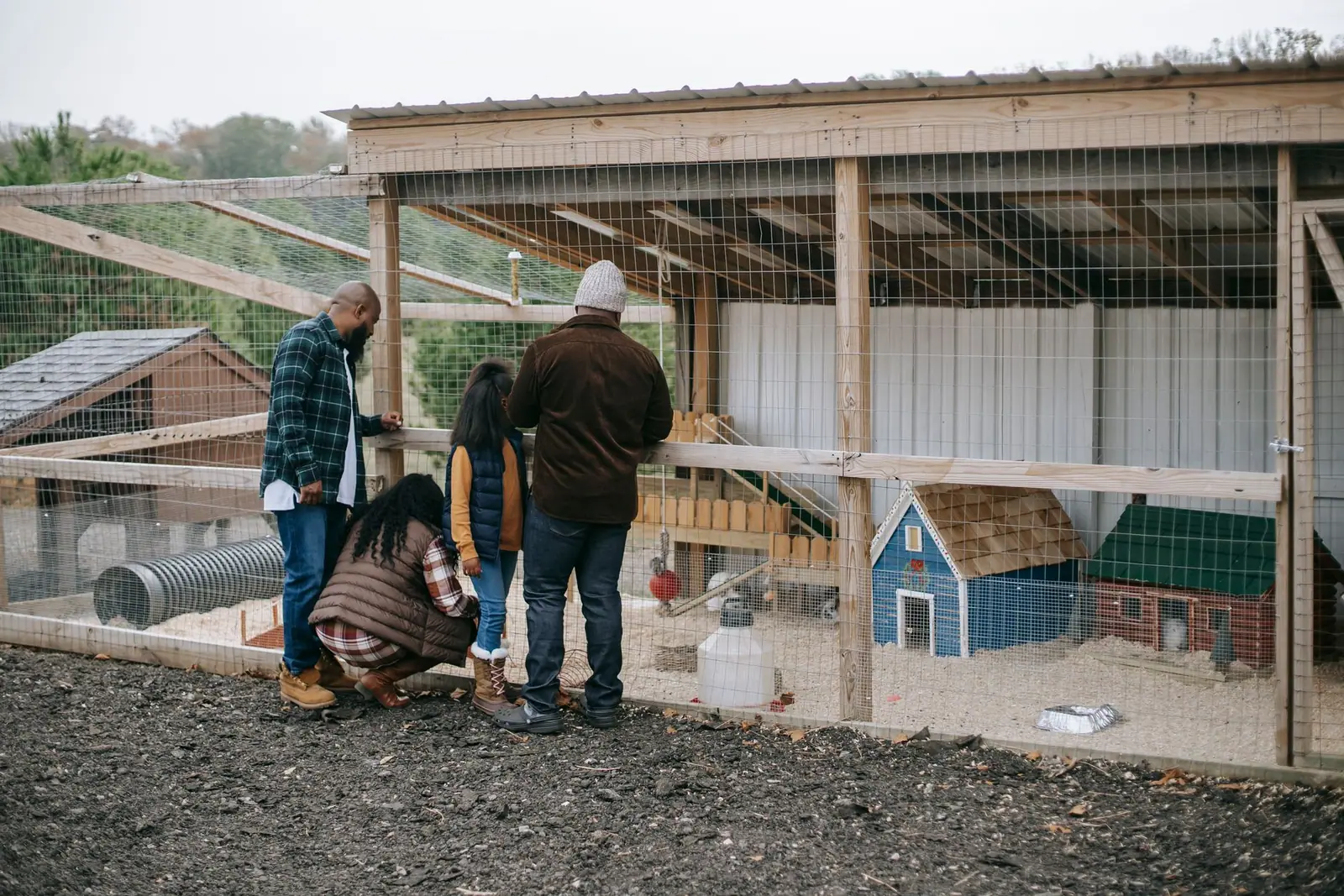
The manufacturer examples below were checked in October 2026. They identify covers sold for Omlet runs, not universal roof kits or a national installed price. The cover photograph shows a roofed mesh poultry enclosure; it does not establish the structure’s load capacity or identify one of the products in the price table.
Key figures
- $70 Omlet clear 6 × 6-foot cover
- $160 Omlet clear 9 × 12-foot cover
- $180 Omlet heavy-duty 9 × 12-foot cover
Flexible run covers list $70 to $180 in these sizes
Omlet’s U.S. weather-protection catalog lists clear and heavy-duty covers by nominal run size. The heavy-duty material provides a different shade arrangement from a clear cover. Confirm the compatible run and included attachment method before substituting the same area of an unrelated tarp.
| Nominal cover size | Clear cover price | Heavy-duty cover price | Heavy-duty premium |
|---|---|---|---|
| 6 × 6 feet | $70 | $75 | $5 |
| 6 × 9 feet | $85 | $95 | $10 |
| 9 × 9 feet | $125 | $140 | $15 |
| 9 × 12 feet | $160 | $180 | $20 |
Source note: Omlet U.S. Outdoor Run Weather Protection listings, checked October 2026. Sizes are the manufacturer’s nominal labels; prices are covers rather than installed structural roofs. Check stock and any additional checkout charges for the selected item.
- 6 × 6 feet$75
- 6 × 9 feet$95
- 9 × 9 feet$140
- 9 × 12 feet$180
Source note: Omlet U.S. Outdoor Run Weather Protection listings, checked October 2026. Sizes are the manufacturer's nominal labels; prices are covers rather than installed structural roofs. Check stock and any additional checkout charges for the selected item.
The $75 6 × 6 example divided by 36 nominal square feet is about $2.08 per square foot. The $180 9 × 12 example divided by 108 is about $1.67. The larger product’s lower area ratio does not make it a cheaper order for a small run: buying it still costs $105 more.
Select the size and cover function first. A $5 material premium for the small example can be minor beside a mismatch in shade or fit. A clear cover allows more light through, while heavy-duty material can create shade; neither choice should be made from color alone without considering the location and season.
A tarp is not a structural snow-load rating
A flexible cover can intercept rain and help keep areas dry, but the frame below carries the resulting loads and attachment forces. A cover’s weather-protection description does not certify that every run can support snow, standing water or a rigid roof added later.
Watch how runoff leaves the enclosure and where it lands. Water shed onto a doorway or back toward the coop can move the mud problem instead of resolving it. Wrapping every side to stop wind can also reduce airflow, so weather protection needs a ventilation arrangement rather than an entirely sealed pen.
University of Maryland’s backyard poultry HPAI guide recommends keeping birds indoors or in covered runs to reduce contact with wild birds, with feed and water protected. That disease-prevention function is different from a manufacturer’s claim about the weight a roof can carry. A roof also does not close all gaps that small wild birds can use.
The coop ventilation guide explains the airflow requirement. The avian influenza guide covers the broader biosecurity plan. Do not present the roof purchase as eliminating disease exposure or all predator access.
Overhang and roof shape change the quantity to price
For a hypothetical 8 × 12-foot run, the floor footprint is 96 square feet. Adding six inches on each of the four sides creates a 9 × 13-foot horizontal roof projection, or 117 square feet. The 21-square-foot increase is about 21.9% above the floor footprint.
That arithmetic is not a recommended overhang or a roof design. It shows why estimating material solely from the run’s floor can miss area. The roof slope, panel overlaps, edge details and cutting losses can increase the purchased quantity beyond the horizontal projection.
Ask the contractor to list roof dimensions and the material being supplied. Count panels or sheets from the chosen product’s coverage dimensions, not its raw width when overlaps reduce coverage. A sheet-count estimate should also distinguish purchased waste from material installed on the structure.
For replacement work, describe what is removed. A quote to install sheets onto a sound frame is a different job from repairing posts or adding new beams. Agree on how hidden deterioration changes the estimate instead of allowing a cheap cover proposal to become an unpriced rebuild.
A rigid-roof quote includes supports and labor
Use an explicitly hypothetical quote of $650 material, $450 labor and $50 removal or disposal. The subtotal is $1,150. It is a worksheet, not a national roof price or a quote for the enclosure pictured on the cover.
If site work or support repairs add an assumed $250, the total becomes $1,400. If disposal was already included in labor, adding another $50 would count that work twice. Ask for the scope of each line rather than accepting a rounded total that leaves supports or cleanup unspecified.
Dividing the $1,150 example by the original 96-square-foot floor gives about $11.98 per floor square foot. Dividing by the 117-square-foot roof projection gives about $9.83. Both use the same total but different denominators, so two contractors’ area rates cannot be compared until the measured area is aligned.
A $75 flexible cover and a $1,150 rigid-roof project differ by $1,075, but that gap is not a saving for the same work. The rigid project includes an assumed construction scope; the cover supplies a flexible material for an existing compatible frame. Compare like arrangements before treating the lower figure as the whole roof budget.
Replacement and daily access affect the longer budget
For a hypothetical five-year period, replacing a $75 cover every year would total $375 before added charges. Replacing it only twice over that period would total $150. Neither is an Omlet service-life claim; the examples show why an assumed replacement interval can dominate a long-term comparison.
A rigid roof can also require repairs and maintenance. A five-year calculation that assumes zero repair cost is an assumption, not a warranty. Record the roofing product, attachment instructions and the installer responsible for the supports so later work can be quoted against the existing construction.
Include access to feeders, drinkers and every part of the run. An installer should not create a roof that obstructs a cleaning door or makes a damaged fitting impossible to reach. Preventing daily care work can cost more than a small material saving.
Have a builder assess the proposed supports, attachments, drainage and local weather loads before adding a rigid roof. Follow the cover maker’s instructions for a flexible product; neither an area calculation nor a stock photograph establishes structural capacity.
The backyard chicken care budget keeps housing purchases separate from continuing feed and care. The free-range versus run guide covers how the enclosure fits the daily access plan. Once the roof is installed, inspect damage and runoff after weather, keep food and water protected, and maintain the flock’s observation routine. Shade and shelter make care possible; they do not replace it.
Questions people ask
How much is a chicken-run cover?
The named Omlet examples list $70–$160 for clear covers and $75–$180 for heavy-duty covers across the four sizes. Those are product prices, not structural roof installations.
Does a tarp make the run safe under snow?
A flexible cover does not establish the frame's load capacity. Follow the cover instructions and have the supports assessed for the local weather and proposed roof.
Can roof area be measured from the run floor?
The floor is a starting point, but overhang, slope, overlaps and waste change the quantity. The hypothetical 8 × 12 run becomes a 117-square-foot horizontal projection with six-inch overhangs on all sides.
Is a covered run enough to prevent avian influenza?
It can reduce wild-bird contact as part of biosecurity, but it does not eliminate exposure. Protected feed and water, hygiene and the rest of the flock plan remain necessary.
Where these figures come from
- Outdoor Run Weather Protection: Cover Prices Omlet · omlet.us
- Backyard Poultry HPAI Protection Guide University of Maryland Extension · extension.umd.edu
- Raising Chickens for Eggs: Housing and Care University of Minnesota Extension · extension.umn.edu
Figures last checked October 2026.