On this page
A cat fountain’s purchase price is only the first expense. Carbon filters, other model-specific parts and cleaning continue after the pump is plugged in. For a small device, the filter replacement schedule can have a larger effect on the yearly bill than a small difference in electricity use.
This guide uses PetSafe’s Pagoda and its compatible carbon filters as a published-price example checked in October 2026. The electricity examples use clearly stated assumptions because a product’s voltage or maximum adapter rating does not establish its measured power draw. Replace those assumptions with a meter reading and the household’s electricity rate.
Key figures
- $89.95 PetSafe Pagoda 70-ounce water fountain
- $9.99 PetSafe compatible carbon filters, four-pack
- $69.93 Example: yearly filter packs, replaced every two weeks
The $89.95 fountain has a separate consumables budget
PetSafe lists the Pagoda at $89.95 with a capacity of 70 U.S. fluid ounces, about 2.07 liters. The product includes the bowl and tower, pump, adapter, one carbon filter and one foam filter. It has two falling streams and an open bowl that retains accessible water if electrical circulation stops.
The compatible carbon filter product is PAC00-13906, listed at $9.99 for four. The fountain also identifies a different foam filter and a replacement pump. Those parts are not interchangeable with every other filter sold under the same brand name.
| Published item or operating assumption | Value | Budget significance |
|---|---|---|
| Pagoda base purchase | $89.95 | One-time equipment cost |
| Compatible carbon filters | $9.99 for 4 | $2.4975 per filter before tax or delivery |
| Manufacturer carbon interval | 2–4 weeks | Depends on the stated use and cleaning routine |
| 52 weeks at a 4-week interval | 13 filters | Four packs provide 16 filters for $39.96 |
| 52 weeks at a 2-week interval | 26 filters | Seven packs provide 28 filters for $69.93 |
Source note: PetSafe Pagoda and carbon-filter manufacturer pages, checked October 2026. Annual quantities are calculations from the published interval. They show 52 weeks of replacement demand and whole-pack purchases, not a guaranteed first-year bill for every household.
The initial included filter can reduce early replacement purchases, while filter stock already owned can shift checkout spending into a different year. Record starting and ending stock rather than describing the whole-pack totals as the amount every new owner must buy immediately.
Whole-pack spending differs from the cost of filters used
At $9.99 divided by four, thirteen filters represent $32.47 of supply used. Buying four packs costs $39.96 and leaves three filters from those packs. Twenty-six filters represent $64.94 used; seven packs cost $69.93 and leave two.
That difference matters when comparing receipts with a yearly operating worksheet. A stock purchase is cash spending, while the filters left over are available for the next period. Counting both the full purchase and the filters used as two expenses would double-count the same supplies.
The filter product page gives 2–4 weeks, while PetSafe’s Pagoda cleaning support page says to replace both carbon and foam filters monthly. Those instructions are not identical: four weeks is 28 days, while calendar months vary. The table shows the filter product’s interval, not a promise that every Pagoda follows thirteen changes. Confirm the model’s current routine with support and replace sooner when its condition requires it.
Shipping and tax can also affect small repeat orders. Buying several packs at once may reduce delivery charges, but only if the supplies match the model and will be used. A cheap bulk pack for a different housing can produce waste rather than savings.
Electricity is calculated from watts and hours
For a device operating continuously, annual energy is watts divided by 1,000, multiplied by 24 hours and 365 days. Every watt of continuous draw therefore corresponds to 8.76 kWh per year. Multiply the result by the household’s applicable energy price.
The following examples assume continuous operation and $0.15 per kWh. These wattages are worksheet inputs, not measured Pagoda ratings or a national electricity price.
| Assumed continuous power | Energy over 365 days | Cost at assumed $0.15/kWh |
|---|---|---|
| 2 watts | 17.52 kWh | $2.63 |
| 3 watts | 26.28 kWh | $3.94 |
| 5 watts | 43.80 kWh | $6.57 |
Source note: arithmetic using stated power, time and tariff assumptions. Measure the installed device and use the household’s rate for an estimate of its electricity expense.
- 2 watts$2.63
- 3 watts$3.94
- 5 watts$6.57
Source note: arithmetic using stated power, time and tariff assumptions. Measure the installed device and use the household's rate for an estimate of its electricity expense.
A 15-volt label, for example, describes voltage rather than watts. An adapter’s maximum capacity may exceed what the pump draws in routine operation. Avoid presenting an adapter label as a measured annual consumption result without verifying the electrical information.
Combining the assumed 3-watt electricity line with four purchased filter packs gives $43.90 before foam filters, replacement parts, cleaning water, tax or delivery. Combining it with seven packs gives $73.87. These are transparent partial operating examples, not an all-inclusive annual guarantee.
Cleaning remains necessary when filters are replaced
PetSafe’s Pagoda cleaning guide calls for full disassembly and cleaning monthly, or approximately every two weeks in multi-pet or heavier-use households. It specifies monthly carbon and foam replacement, so include foam supplies in the final quote even though the table prices carbon only. The product page permits dishwasher cleaning of the other parts while requiring hand washing of the pump. Filter replacement does not remove hair, debris or buildup from every component.
Keep cleaning tasks in the comparison with a plain water bowl. A fountain has extra components and crevices, and an unmaintained pump can perform poorly even with a new filter. Follow the guide’s unplugging and reassembly instructions rather than cleaning around a running electrical device.
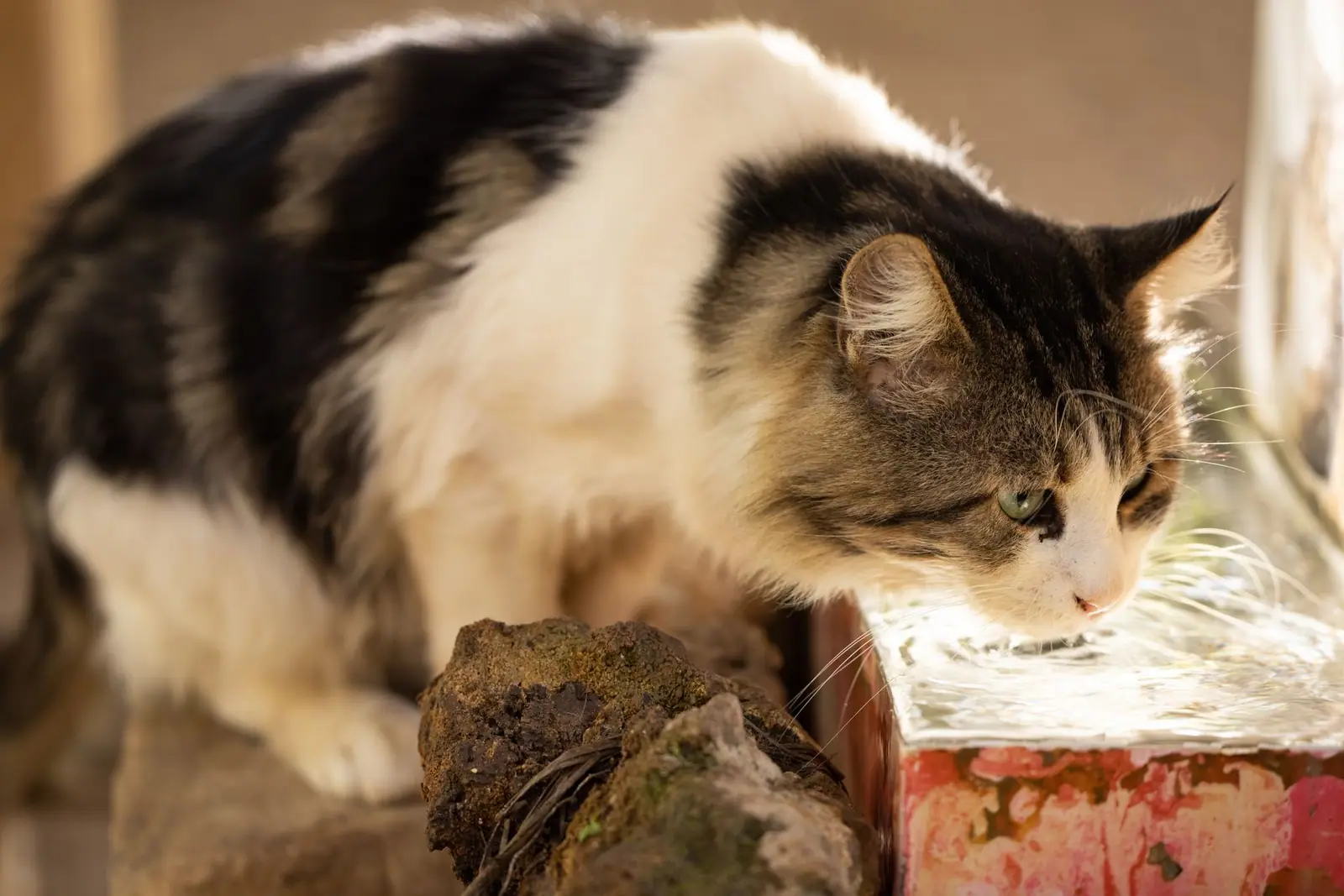
The cover shows a cat drinking from a stone fountain to illustrate flowing water; it is not a photograph of the Pagoda model. The quoted product and filter prices come from PetSafe’s published pages, not from identifying equipment in a stock image.
Drinking access matters more than a claimed medical saving
The cat drinking guide discusses water access and observing intake. Some cats may use moving water, while others prefer bowls. A purchase cannot establish that a cat drinks enough, and the amount stored in a reservoir is not a daily intake target.
Ask the veterinarian about a new change in thirst, intake or urination. A fountain purchase cannot diagnose or prevent every urinary problem, and a cat straining with little or no urine needs urgent care rather than a new drinking accessory.
Include the purchase, filters, measured power and maintenance in the adult cat care budget. If another person provides care while the household is away, the sitter cost comparison keeps checking and cleaning the water equipment within that person’s task list.
The decision is clearer when the household can see both the recurring supplies and the work involved. A low electricity bill does not make filters free, and a full reservoir does not make the system unattended care. Compare the maintained fountain with the maintained bowl, then choose the water setup the cat uses reliably.
Questions people ask
How much does a cat fountain cost to run?
For the named PetSafe filter example, four or seven four-packs cost $39.96 or $69.93 to cover calculated 13 or 26 filters, before other supplies. A hypothetical continuous 3-watt device adds $3.94 yearly at an assumed $0.15/kWh.
Are fountain filters replaced monthly?
Follow the model's instructions. PetSafe's compatible carbon filter page lists 2–4 weeks. Four weeks is 28 days, so 52 weeks contains thirteen four-week intervals rather than twelve calendar months.
Can I use the adapter rating to calculate electricity?
Voltage alone is not power draw, and an adapter's maximum output may exceed normal use. Use measured watts and operating hours, then multiply kWh by the household's energy rate.
Does a new filter mean the fountain is clean?
No. The bowl, tower and pump still need the manufacturer's cleaning routine. Keep another accessible water source while the fountain is cleaned or out of service.
Where these figures come from
- Pagoda Fountain: Price, Capacity and Included Parts PetSafe · petsafe.com
- Compatible Carbon Filters: Price and 2–4-Week Interval PetSafe · petsafe.com
- Disassembling and Cleaning the Pagoda Fountain PetSafe Support · support.petsafe.net
Figures last checked October 2026.